Apparently it’s impossible to not compare yourself but here’s what you can do instead

I’ve been told time and time again that I shouldn’t compare myself to other people’s lives, and I completely agree with it. But it’s also the hardest thing to do. I even left social media so I wouldn’t and I STILL have a problem with comparing myself.

Turns out, we humans might just be hardwired that way. Social psychologists Adam Galinsky and Maurice Schweitzer wrote a book all about it, citing studies of monkeys and moving onto humans. Check this out, my dudes:

University scientist Frans de Waal. De Waal trained capuchin monkeys to essentially use stones as a kind of currency, exchanging one for a nice cucumber slice. The monkeys were perfectly happy with this arrangement, until de Waal started giving some, but not all, of the monkeys a sweet, juicy grape instead of the cucumber.

“Upon seeing this inequity, the monkey who was offered the regular cucumber went, well, apeshit,” Galinsky and Schweitzer write. The monkeys who perceived themselves as receiving a lesser deal became visibly upset, refusing to pay for the cucumber or sometimes throwing the slice back in the experimenter’s face.

And I thought that I was petty for deleting people from social media. (Note: it is a healthy thing to do even if you feel mega-guilty about it, which is a tendency of mine, but I am also much happier for it, although it’s easier to just leave social media altogether.)

They then move onto the human example:

For a human example of this phenomenon, Galinsky and Schweitzer tell the story of a man named Scott Crabtree, who had dutifully climbed the corporate ladder at his company, steadily earning incremental raises. He was fine with this — until, that is, a just-out-of-college kid was hired and immediately began earning almost the exact same salary as him, a figure that had taken Crabtree decades to earn. The infuriating comparison made him so unhappy that he soon left the company, where he’d happily worked for many years.

So – I’m not alone in my jealousies and rivalries and schadenfreude when someone I can’t stand fails in their endeavors.

The biggest takeaway from the article is to let these jealousies and rivalries motivate you, rather than completely ruin your life. If you’re jealous of someone, figure out what they have that you want – and then go for it – within reason. We’re not killing anyone’s spouses.

The only problem – and the article points this out – is that rivalries can only motivate you so far. Sure, if you’re running a race against that jerk who somehow effortlessly excels at everything s/he does, then by all means race your heart out. But then if you end up finishing behind that person, well, you’re kind of miserable.

It’s tough balancing cooperation and competition, but the authors don’t necessarily advocate one over the other. It’s dynamic balancing act:

Galinksy and Schweitzer write that “when it comes to using social comparison to boost your own motivation, here is the key rule to keep in mind: Seek favorable comparisons if you want to feel happier, and seek unfavorable comparisons if you want to push yourself harder.” You may not be able to quit your social-comparison habit, but you can learn to make it work for you.

My personal take? Let jealousy motivate you to get out of a rut, but maybe rein in the schadenfreude. Even when it is so, so tempting.
My own friendship complex

Yesterday morning I woke up too early for a weekend: 5 a.m.

I decided not to fight it and try to go back to sleep, but instead turned to my phone and started scrolling through my Google feed. I found this story on Man Repeller written by Haley Nahman about why it’s so hard to make friends as an adult:

The catalyst for my spiral was a reappraisal of my social life and the re-emergence of a latent, enduring belief that mine has never measured up. It only took a few days for the idea that I didn’t have enough friends in New York to take shape in my mind and solidify into a dense gray cloud that followed me everywhere. It was a familiar feeling — friendship insecurity has troubled me most of my life — but its persistence into adulthood felt ominous. How was I still here?

Me too. How am I still here?

Maybe I romanticize childhood friendships too much, or maybe I thought friendships would get easier going into adulthood, but both expectations resulted in deep loneliness and dissatisfaction.

I think people (incorrectly) think that childhood friendships were so easy – “Hey, you like Barbies? You wanna play Barbies with me?” “Yeah! Let’s be friends!” – and when middle school and puberty hits, the mean girls and jocks emerge and destroy all that whimsy with a hearty reenactment of Lord of the Flies, but with less murder.

That’s simply not true. I have vivid memories of boys singing “Pop goes the weasel” at me until I cried. Another time during recess I was hanging out with a girl who I thought was a friend when she asked me, “Why are you following me?”

I appreciate that Nahman doesn’t romanticize childhood friendships. She acknowledges that the early childhood structure of friendship is rather unstable, and that she has yet to meet an adult who hasn’t had some kind of complex left over from high school.

Social insecurities seem to carry a disproportionate amount of shame as a result. The fear of friendlessness is deep-seated, codified into our malleable brains at too vulnerable an age to be easily dismantled. I feel fairly certain this is true, and yet, like the human-shaped pile of contradictions that I am, I still manage to believe everyone’s fine and definitely hanging out without me.

There’s a strange, sad irony to all this: everyone’s lonely and isolated, but nobody’s talking about it. Everyone’s feeling vulnerable, but we just keep up the facade that everything is okay.

If childhood insecurities scar us into adulthood, modern media seems to only deepen those wounds. Every day on our social feeds, we watch as people publicly curate their lives, feeding a constant stream of invisible omissions which, while understandable, present a false reality. Movies and shows don’t help either, with their charming ensemble casts that meet twice a week — once for brunch, once for drinks. Who’s living like that?

Add to all that the recent focus on female friendships in the mainstream which, although wonderful for many reasons, has also given what are complex, messy relationships a sort of invincible, performative sheen. Maybe some people really do have that perfect, evergreen kind of friendship, but I would guess it’s less common than we think.

I’m so grateful for the focus on female friendships. It’s been a long time coming, and I have had some of the most meaningful relationships in my life come from my female friends. But the pendulum has swung so far in the other direction that I feel like a failure for having less friends than fingers on one hand, and sometimes even those friendships are not without their flaws.

I’m actively working on making friends wherever I can: I get along with everyone on my team at work, I communicate with the family members who I know will reciprocate, and I hang out with the two friends that I do have.

But it’s a constant work in progress, and sometimes I break down and I cry.

Which is why this article resonated with me. So if you haven’t read it yet, I strongly recommend you do, and then go reach out to someone and keep trying to make friends with people, even when it feels impossible.

Winter hiking to Lake Blanche

So as I’ve mentioned before, I signed up for the #52hikechallenge. I love winter hiking, and what better than a challenge to get me outside even more?

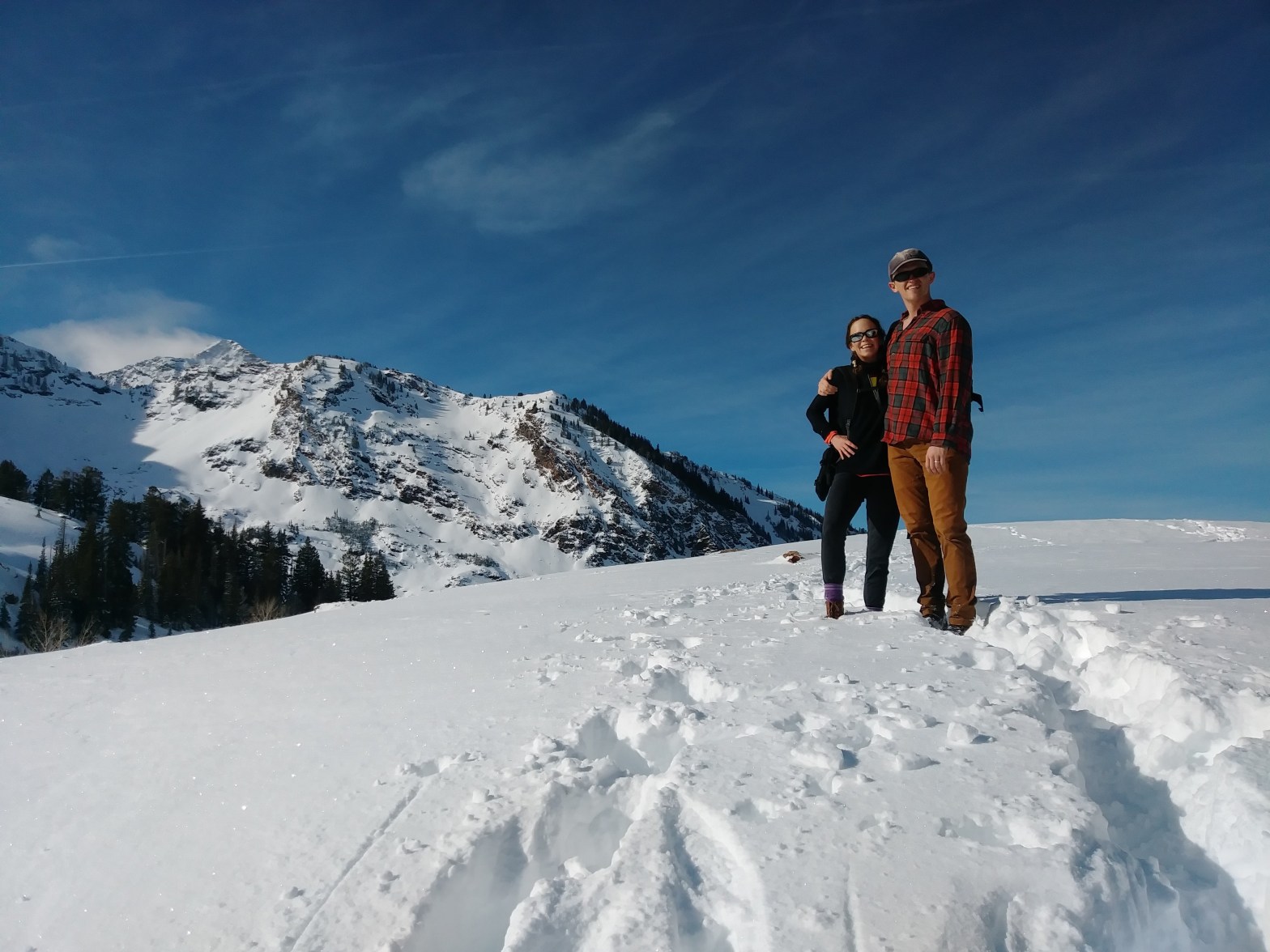
Austin and I hiked to Lake Blanche just the other week. The trail says it’s 6.9 miles, but my phone clocked about 7.9 miles. I think my phone was also counting walking from where we were parked.

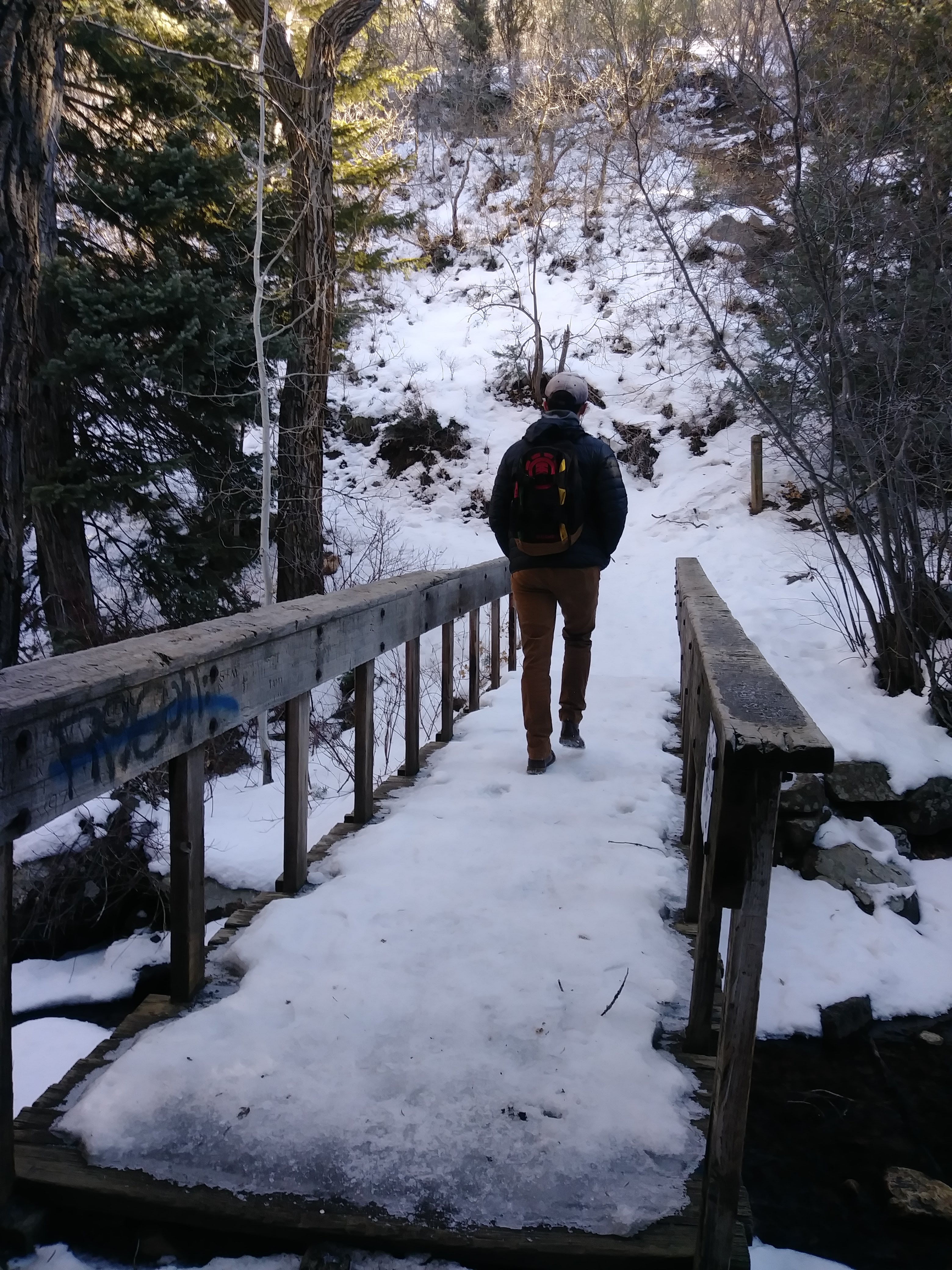
It was one of those hikes where you start off waaaaayyyy bundled…

20180113_100343.jpg

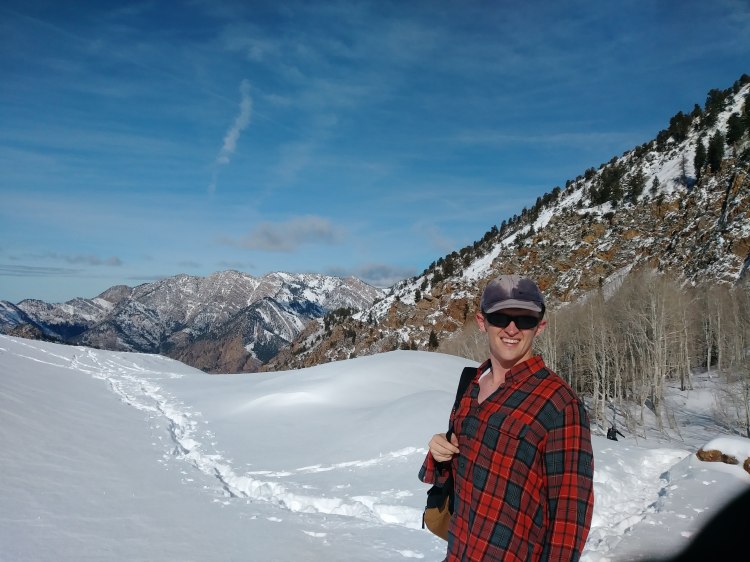
…Aaaaaannnd then shedding most of your layers by the end.

20180113_113143.jpg

Austin has had that hat ever since we hiked Scotland, and it used to be a lot darker until the salty sweat bleached out the color. #sweatypeopleprobs

20180113_113420
Sundial Peak and the mostly frozen lake – I wasn’t willing to take my chances though

When we reached the lake, we ate leftover Domino’s pizza as part of our meal, and I gotta say, that’s the tastiest trail food I’ve ever had.

20180113_113930.jpg

We couldn’t stay still for too long, though – the cold started getting to us and we had to get moving.

20180113_113432
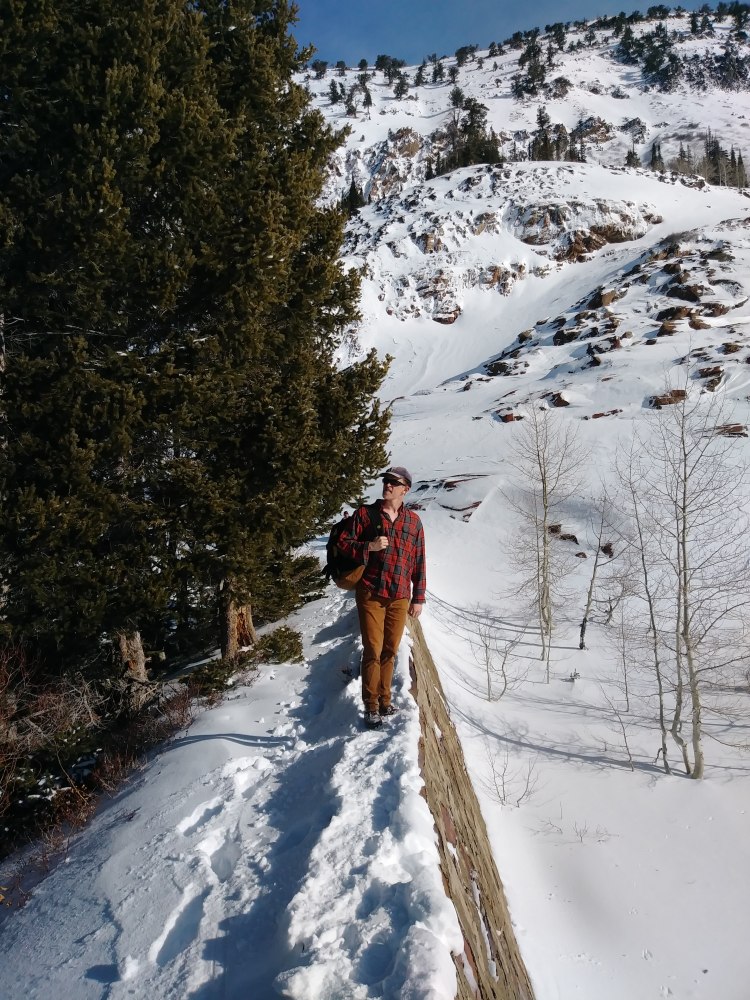
I think this is a dam Austin’s standing on

We didn’t bother bringing snowshoes with us, although they probably would’ve been more useful toward the end as the snow got deeper.

20180113_122548.jpg

Do you ever look at your own photos and think, “Wow, I live in a stunning place” and just want to get back out there?

20180113_110326.jpg

Dude, this place rocks.

3 reasons why you should visit Moab in the winter

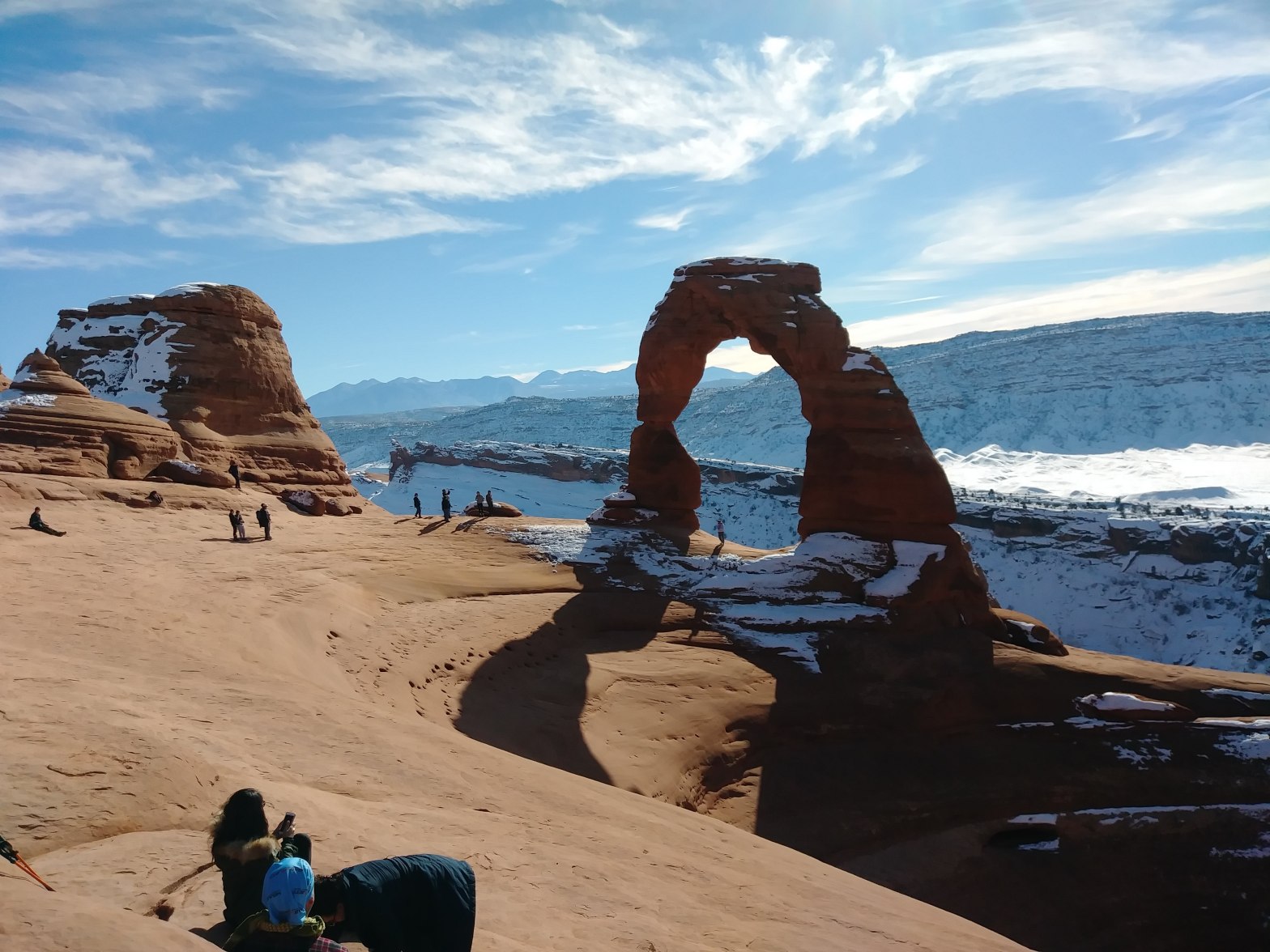
I love Arches – it has a special place in my heart; probably because I was born and raised in Utah and Delicate Arch is what you see on many Utah license plates.

Austin and I hiked there last Saturday. It was a good hike. Here’s why you should visit Moab and all its surrounding attractions in the winter:

1. There’s less people

If you go to Zion National Park, Arches National Park, or anywhere that is highly popular, there will ALWAYS be people – even in December and January.

20171230_114329

But there will be LESS of them. Less disputes over parking, more campgrounds. I’m convinced that parking disputes are at least one of the primary reasons why most people hate crowds.

20171230_113634(1)

2. The snow and sandstone makes for unearthly beauty

Look at this:

20171230_122040

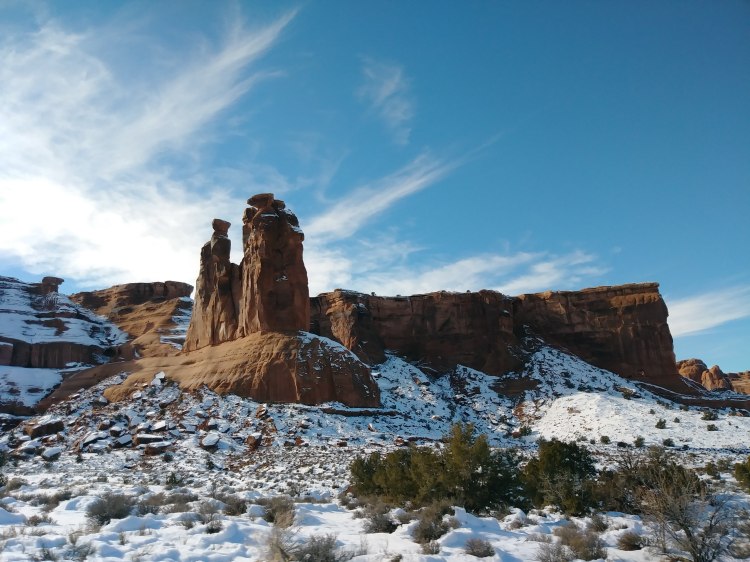
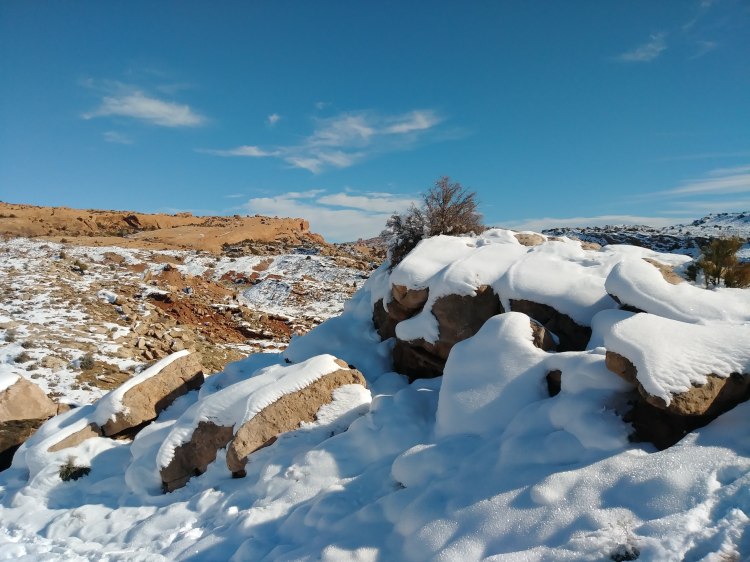
How stunning is that? What a colorful combination of red rock, white snow, green shrubs and bright blue skies.

20171230_112247

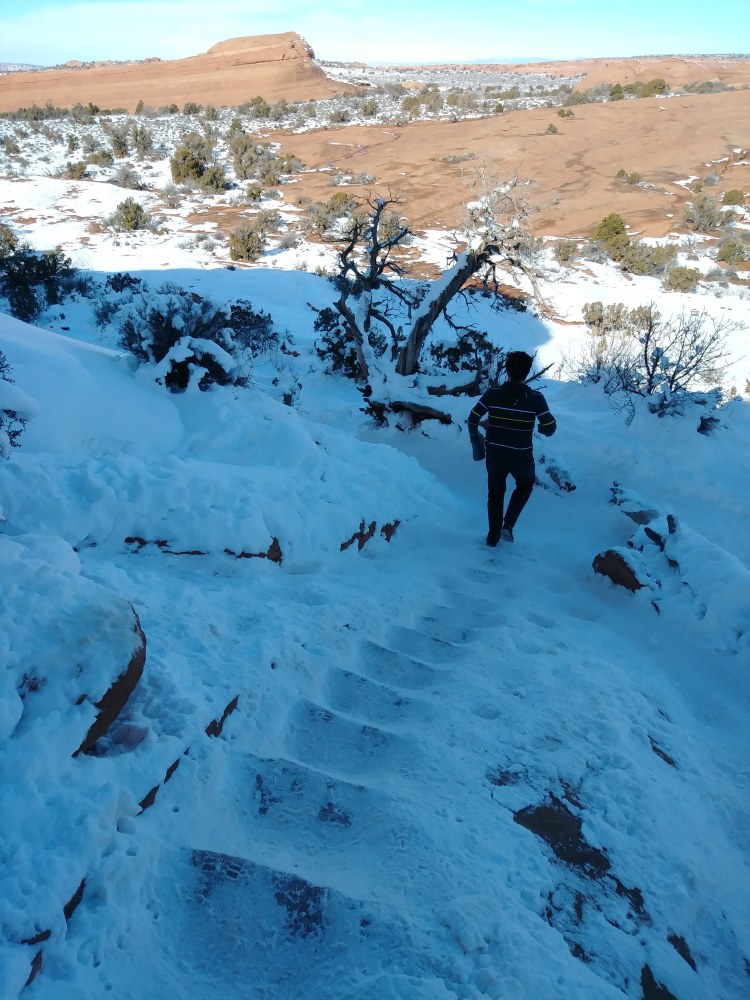
The sandstone with the snow sometimes made for decent traction – the more crumbly bits of rock and sand that mixed in with the snow, the better traction. Unfortunately this was not universally true – there were some particularly slick bits and I saw someone wipe out. Take it easy and be safe.

20171230_111824
This spot was the most slippery

3. It’s still decently good weather

20171230_105300

Granted, you should still wear a jacket. Be sensible – this isn’t Hawaii, and there’s always a chance the weather will be bad. But it’s a lot better than what they’re experiencing in Florida right now, amirite??

(I do feel bad for Florida, that weather is insane)

20171230_113405
These stairs were terrifying to go down

It was a clear day when we went. It made for a good hike and warmed us up so much more easily.

20171230_115658

If you get the chance to go to Moab during the winter, take it – you’ll get more out of it than you realize.

My very exciting and hopefully somewhat realistic 2018 Bucket List

I had a good 2017 and accomplished a lot – here’s to a fantastic 2018! Here’s a list of everything I’d like to accomplish this year:

1. Finish the #52HikeChallenge

I signed up this weekend and already accomplished two different hikes! I’ll write about them this week. I’m really excited about this challenge – I’d been waffling about it off and on until I decided to just bite the bullet and go for it. It’ll give me an awesome opportunity to discover all of the hidden hikes in Utah and even venture outside of Utah for some more!

2. Summit the rest of Utah Valley’s 7 peaks

This was a goal I made last year. Utah Valley/Utah County has more than seven peaks, but there’s seven that I’ve been dying to do. Here are the seven and the elevation at which they stand. I’ve completed the bolded ones.

Mount Timpanogos – 11,750 ft
Mount Nebo – 11,928 ft
Cascade Mountain – 10,908 ft
Lone Peak – 11,253 ft
Provo Peak – 11,068 ft
Santaquin Peak – 10,687 ft
Spanish Fork Peak – 10,192 ft

3. Run another marathon

I ran 2 marathons this last year. I’m thinking that one should be sufficient, but it’d be great to knock out another one. Maybe Ogden Marathon again? Or should I do a different one to get out of Utah?

4. Visit the Bonneville Salt Flats

I’ll admit that I got this idea from watching The Last Jedi – there’s a scene that takes place on salt flats. Although those salt flats aren’t the same ones as in Utah (they’re in Colombia), I’m trying to take advantage of being a tourist in my own state and see what otherworldly experiences it has to offer. I’ve always wanted to see the Bonneville Salt Flats, and I’d like to make it happen before the end of winter.

5. Go winter camping at least once

My very generous sister-in-law gifted us with -25 degree sleeping bags. And we’ve got some good pads. Austin isn’t as thrilled as me, but I’d like to do it at LEAST once. Besides, it means we can get out of the house as well.

What about you? What bucket list items do you have for the upcoming year?

2017 was not a dumpster fire year, in spite of what the internet thinks

Let me get it out of the way: I do not love the way politics went in the United States.

But I really struggle with the constant narrative dominating the internet that 2017 was the worst year.

Really? Was it really the worst year ever?

What about 1347, when the Bubonic Plague wiped out a third of the human population? Or maybe 1975-1979, the years of the Cambodian Genocide? What about 79 AD when Vesuvius erupted, burying the entire city of Pompeii and its residents? That was LITERALLY A DUMPSTER FIRE OF A YEAR.

Look, I get it. I’ll say it again: I did not love the way politics went this year.

But sadly, I also expected them to go that way because the candidate I did not vote for ended up winning and the congress I did not vote for is running the show. There are white supremacists and extremist groups on the rise. Affordable healthcare is in an uncomfortable limbo at the moment and getting into territory that could raise costs even more. Trump has made numerous attempts on banning refugees and making the vetting process even more difficult than it already is.

There’s some serious crap happening, and I understand the cynicism. After all, isn’t this 2017?  We ask. Shouldn’t we have gotten our act together by this point?

For a world with such incredible technological and medical advancements, we still haven’t nailed basic human decency. If people are murdering their own people in the next country over, the least we can do is let the refugees come stay in our country, right? People should be able to get treated for their illnesses without getting into crippling debt, right? Why are there so many mass shootings? Is nobody listening anymore?

And worst of all, it feeds into this tiny fear lurking in the back of our brains: are we letting our society just get worse and worse until we’ve doomed ourselves without realizing it?

So, yes. I understand. A lot of crap is happening, and it sucks to know how little control I have over these problems.

But I think society at large is still getting better. Some candidates I voted for this year in local elections have won. Across the country (and world, for that matter) you see citizens taking matters into their own hands and are peacefully voting, participating, engaging. They are making positive change happen.

You know what else is amazing? People are believing victims of sexual assault. Perpetrators are facing actual consequences of their actions. We’ve got a long way to go, but it’s a refreshing, emboldening start.

Google it and you’ll see: good stuff did happen this year. When the solar eclipse happened in the northwestern hemisphere, strangers were making friends with each other and sharing eclipse glasses. People were obsessed with it and it was delightful participating in this natural phenomenon.

A college student missed his graduation because he was stuck on the subway, but no worries – the people on the train held a makeshift ceremony for him.

The ALS ice bucket challenge actually worked, raising $115 million in donations. The ice bucket challenge was in 2014, but this year Israeli scientists were able to develop a new treatment, which was shown to increase life expectancy.

Chance the Rapper donated $1 million to Chicago public schools as a call to action. Talk about using your power for good. Twitter is finally starting to censure hate groups. Even with all the hurricanes happening this year, it’s been encouraging to see all the relief workers and the best of people coming out.

I’m trying myself. I’ve donated to charities and movements to improve policies, even if it’s as little as $3 for Wikipedia. This year I volunteered at a women’s shelter to make just a tiny difference – and honestly, most of what I did involved sorting donations and watering the plants. I’ve tried to be a little less self-absorbed and actively work to bring value to my environment, from my family to my friends to my coworkers.

So much good happened this year. So much.

It doesn’t cancel out the bad. It doesn’t make certain situations any better. But goodness exists. It’s out there. For every evil CEO screwing over others, you’ll find the person sacrificing their salary so they don’t have to fire anyone. You’ll see people taking care of their parents as old age starts to take its toll.

Look for the good and you’ll find it.

What I did in 2017

The biggest thing I got into this year was…wait for it…

BULLET JOURNALING

Okay, so that’s a bit anti-climactic. But I don’t think I could’ve accomplished half of what I did this year had I not been so persistent with my bullet journal.

20171221_152811
I was listening to a Vampire Weekend song while doodling on the right page

Thanks to my bullet journal, I:

  1. Got laid off but compiled my best interview questions, assessments, and companies I wanted to apply for
  2. Hiked the Y at least two dozen times, achieving a PR of 22 minutes to the top (this is a beastly hike)
  3. Got another job that pays a ton better and has ~*benefits*~
  4. Ran a marathon in May
  5. Paid off our car
  6. Volunteered at a women’s shelter for 6 months – when I was doing training for the volunteer work, I attended workshops that taught us about what constitutes healthy relationships, boundaries, and resources that exist for victims of domestic violence (both women and children). I wrote about all of these in my bullet journal and still apply the principles in my life.
  7. Did a sprint triathlon in June
  8. Camped in Oregon
  9. Summited 3 of Utah Valley’s 7 Peaks
  10. Ran a marathon in October
  11. Read 28 books
  12. Got back into snowboarding

The best part is, I actually remember doing these things. I think we’ve all accomplished more than we realize, we just don’t remember it.

I’m pretty proud of myself for what I’ve done this year. I’ve also recently been inspired by Mountain Maven’s yearly bucket list and I’d love to create that. I’m also planning on signing up for the #52hikechallenge by the end of the week – it sounds intimidating and wonderful and I’m excited.

It’s gonna be another great year.

Standout books I read in 2017

I used to be an avid reader. I’d hole up in my room and devour books, usually Harry Potter. In fact, I read so much that being physically active was NOT a thing in my life.

Now it’s more the opposite. I don’t read like I used to and that’s sad. So at the beginning of 2017 I made a goal to read 26 books, which meant I was reading a book every two weeks.

And guess what? I read 28.

I read a mixture of light and fluffy books, a few classics, some self-help, and a couple of contemporary fiction and nonfiction. The books that have stood out to me this year are:

Anna Karenina

This book was a BEAST – it took me about a month to finish it. I listened to it on Audible and Maggie Gyllenhaal read it.

This book is an excellent insight into the human psyche. I am so impressed by how Tolstoy peered into Anna’s mind and explored every thought and emotion and feeling at that moment – just because a character felt one way at one time doesn’t mean it’s universal. It was brilliant.

Because it’s Russian and long, it has a lot of characters to keep track of. The characters you will likely care about the most are Anna Karenina (duh) and a dude heretofore known as Levin. They live opposing lives and scarcely interact with each other, but it’s fascinating to see where their actions and thoughts lead them and the choices they make.

I had to read a lot of SparkNotes and essays on this book. There were times I wondered, “Why is this book so highly regarded?” and I’d google some analyses and read them and gain a better understanding.

Nevertheless, I loved this book. I loved how it made me think, I loved the struggles of the characters, and I loved how much I cared about every single one of them. There were no villains.

The Hate U Give

16-year-old Starr Carter watches a policeman shoot her childhood friend. The book chronicles the way she deals with it and the activism efforts she engages in afterward.

The Hate U Give was engaging and eye-opening about a different side of life I’m unaware of. I liked the voice of the book – Starr came to life for me and her perspective felt so, so real. I understood her initial hesitation to speak up, but then she also saw the consequences of her actions and began making choices. She was a very real person and I felt her pain.

This book is an excellent exercise in believing other’s experiences and practicing empathy and compassion.

Why Not Me? and Bossypants

Mindy Kaling and Tina Fey are hilarious. Their books are full of entertaining stories and good laughs. I listened to both of these on audiobook and they read their own books, so it’s even more fun to listen to them. I’ve never watched The Mindy Project, but I love The Office and 30 Rock.

I recommend both of these books if you’re looking for a good escape from reality and need a good laugh.

At the Existentialist Cafe and Postmodernism 101

These books are easy-ish forays into philosophy. The philosophy world is a pretty tough realm to navigate – too many long words and overly long explanations of nebulous concepts.

At the Existentialist Cafe is largely a history/biography of the biggest influencers in the existential movement: Jean-Paul Sartre and Simone de Beauvoir as the main people, and then quite a few others and their influences on each other. The author Sarah Bakewell was very thorough in explaining both philosophy and biography and how each philosopher was influenced by their life experiences. In the beginning you’ll think, “Wow, Sartre is really cool,” and then by the end you’ll think, “Wow, Sartre’s an arrogant piece of crap.”

Be warned: it took Austin and me about 3 months to finish this book.

You heard the expression “Gender is a social construct”? That’s postmodernism at work. Postmodernism is an attitude of skepticism and rejection of widely accepted ideologies and absolute truth. It rejects the idea of objective reason and the idea of social progression, so it’s a little pessimistic.

Postmodernism 101 is directed at Christians, which was smart. Postmodernism is a scary concept for the religious; it’s one of the motivating factors behind the decreasing religious atmosphere of America today. However, there is so much value to learning about postmodernism and its effects on today’s society and how to think with that mindset.

Overall

I’m really proud of myself. I had a coworker who read 104 books in a year, but reading 28 was just perfect for me. I navigated a variety of books from self-help to fiction to philosophy. I’ve learned a lot from them and I’m excited for the books I’ll read next year.

What about you? Did you read any books that stood out to you this year? Did you love them or hate them?

4 tips for not getting angry when you suck at snowboarding

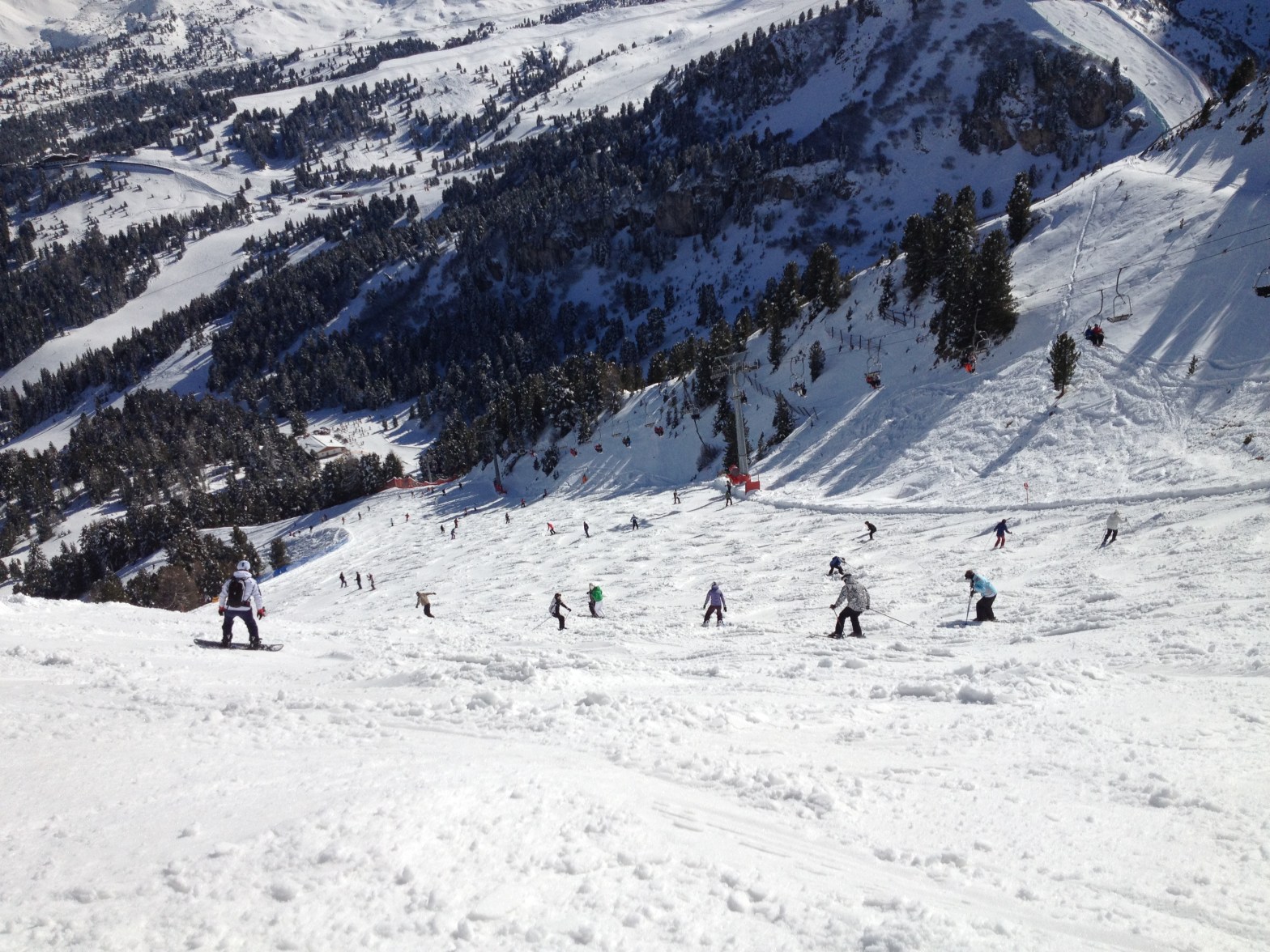
The big lie about snowboarding is that it’s easier than skiing.

There’s a steep learning curve in beginning snowboarding. Unlike yoga or weight-lifting, you can’t just change your mind and stop the pose or drop the weight. Or even if you were out for a long run, you can always walk.

But with snowboarding? Nope – you have to get down that damn mountain.

And you’ll biff it – you’ll land on your butt, you’ll face-plant, you’ll slide out of control and run into trees or people. Luckily, I haven’t run over anyone, but it’s painfully exhausting.

So here’s how I keep myself from going insane – or at least, keep going back – on the slopes.

1. The bunny hill is your friend

Just because you’ve gone on the bunny hill a couple times doesn’t mean you’re good enough for the bigger runs. I mean, you can try, but there will be a BILLION people zooming by you and you will freak out and you might almost run into someone.

Believe me, it’s worth going on the bunny hill to practice. Practice long, wide turns. Practice transitioning from toe-edge to heel-edge. It’s not the best snow – even as a beginner, I recognize the delights of pure powder – but it’s good enough. I’ve gotten so much better at turning and maintaining control of my snowboard thanks to the bunny hill.

Besides, it’s short enough that your mountain-sized panic attack doesn’t last as long.

2. Watch YouTube videos – or hire a teacher

I’ve linked to this guy before and I’ll do it again. This guy’s tips for beginners are solid gold. It’s easier to internalize the tips when you’re actually out on the slopes and not in a cozy bed watching videos on surviving flat and narrow runs (my latest vice). I’ve learned how to do toe-edge from this guy and learned how to turn. Austin’s helped too, which is nice.

If watching YouTube videos are not your thing and you have cash to spare, it’s absolutely worth investing in a teacher. I once was riding a lift and saw a teacher and student work on turning. The teacher said, “I know, your body keeps saying, ‘Nope, I don’t want to do this,’ but you keep working on it.” I took what he said for myself and it’s been comforting.

Teachers are very, VERY encouraging and understand the beginner’s perspective, which is surprisingly easy to forget once you start improving.

3. Know when to quit

Sometimes you work through exhaustion. And sometimes you just call it a day.

I realize that I am very lucky to be able to afford a season pass so I can go snowboarding more often than I ever have. Even so, I have to acknowledge, “Wow, I just started crying after getting off the lift, maybe this will be my last run.”

I’ll be able to come back, so it’s easier for me to know when to stop. However, last year when I could only afford to go snowboarding twice, I would stop in the lodge at the resort and just hang out until I felt ready to go again.

4. Rest up and try again

Sleep, man. Take breaks. Try to eat healthy snacks you brought yourself because those resort cafes are hella expensive.

Once you feel rested enough, get back out there and try again.

I temporarily quit social media over a year ago – here’s 6 ways it’s affected me

Google it and you’ll see: social media is one hell of a polarizing topic.

Either it’s an article on how “SOCIAL MEDIA IS DESTROYING OUR GENERATION” or a defensive article saying something like, “Shut up, I like my social media and leave me alone.”

Personally, I prefer my life without social media, but that doesn’t mean that I’ve never looked back or wonder if it’d be worth it to get back on again. I think there are pros and cons to leaving social media, and this is my experience.

Leaving Social Media

In June 2016, I deleted my Twitter. Then a few months later, I deactivated my Facebook. And then seven months ago, despite having not gotten on in months, I finally deactivated my Instagram. I have approximately eight friends on Snapchat, four of whom I stay in regular contact with. Other than that, my social media life is virtually nonexistent.

Why?

Short answer: superficial friendships, mental health, and wasted time.

Longer answer: It’s difficult to watch people you used to be so close with drift away from you. I can’t exactly romanticize the way relationships were done in the past (I very much prefer the world of today), but the dynamic of friends, acquaintances, and frenemies on social media is a very tricky minefield to navigate because the reminder (i.e. them) is constantly there, even if you unfollow them or unfriend them.

I’ve always been a social person. I used to want ALL THE FRIENDS. I’m decently extroverted and when I’m with people I love, I feel energized and fulfilled.

I didn’t get the energy or fulfillment I craved from social media. I tried to be proactive and utilize it to get together with friends, only to have them flake. I’d try to have meaningful conversations with friends over Facebook messenger, but more often than not those conversations fell short and we didn’t connect the way we used to.

So after a lot of dissatisfaction, I deactivated my accounts and faded out of view. Here’s how it affected me, the good and the bad.

1. I do whatever I want, worry-free

Hiking a beast of a mountain that you can’t summit? No problem, save yourself the energy and dehydration because nobody will see.

Want to stay in tonight and play a mind-numbing video game? Go for it, literally nobody knows that you aren’t out there living the most adventurous life EVERY SECOND OF EVERY DAY, nor do you have the constant reminder and pressure to do something with yourself.

Did you not travel very much this year because you’re trying to save some money and have finally invested in that employer-matched 401(k) you’ve heard so many good things about? As far as you know, neither did anyone else because you aren’t there to see it.

Do you have fewer friends because of the big move you made or you had to cut out some toxic people from your life? That’s okay, because on social media everyone seems to have the best friends or the best family or the best significant other and maybe you’re just trying to be happy with what you’ve got.

2. I have fewer friends now

To be honest, I think I have the same amount of friends that I did when I left – it’s just more apparent how few people are actually in my life because getting on social media and liking someone’s post or stalking someone makes you feel connected to them.

A definite downside is that it’s a lot harder to keep in touch with long-distance friends. I have a good friend from the Philippines and she and I are as close as ever, but another friend just moved across the country and it’s been a lot harder to get in contact with her.

I try to make the small amount of friendships and relationships in my life count. I used to get very, very sad when I’d try to be friends with someone and they weren’t reciprocating. Now I’m more accepting of people’s personal preferences, and I’m nurturing the relationships currently in my life.

3. Still a creeper

You know how you change an aspect of your life and hope that BAM – you’re cured? That’s what I hoped leaving social media would do for me.

NOPE. I still stalk people!

I mean, I’m not Rebecca Bunch levels of stalking – not having any social media actually puts a barrier on that, what a relief – but if I’m curious about someone, I’ll look them up.

Sometimes it’s a good thing; the other week I discovered that an old friend had gotten married and I was really happy for her. But other times it’s just caving into the bizarre, addictive feeling of hate-stalking and it only hurts me in the end.

4. I miss out on big events

My sister-in-law got breast cancer, but I only found out because my sister texted me and asked me how I felt about it. My brother’s son had some health issues, but I didn’t know until a few months later when I saw my brother at my parents’ anniversary.

A friend of mine died and my cousin texted me. Another cousin of mine was pregnant with triplets – I had no idea until I had temporarily reactivated my Facebook to find out the funeral details of my friend’s death.

This, quite honestly, is huge and one of the biggest drawbacks of leaving. It’s one thing where EVERYONE lives without social media, but it’s another thing when you are actively choosing to not engage in one of the more commonly used forms of connection. You’re going to miss things, and that kind of sucks.

5. Less outrage

I don’t miss this. I absolutely do not miss this.

I deleted my Facebook a couple weeks before the election of 2016, and even though the two events aren’t correlated, I was relieved I didn’t have to be there to witness the carnage.

I try to be relatively informed and I stay politically active. I talk with my friends about current events and I try to understand their point of view. But social media is rarely an environment conducive to compassion, understanding, and listening.

6. I’m happy with the life I live

I actively work on making my life something I’m proud of. I’m learning how to be happy for other people. I’m happier with myself and the progress I’m making. I focus on my relationships and look outside my own feelings. I’m more inclined to help other people and make their lives better.

It’s not that you can’t be this way if you’re on social media. But given my tendencies to depression and isolation when I’m on Facebook, Instagram or Twitter, I get increasingly self-absorbed. I’m a lot more present with people now.

Leaving social media was the best thing I could do for my mental health and relationships. Who knows? Maybe someday I’ll return. It’s not for everyone, but being gone has worked out for me pretty well.