Hiking the West Highland Way, part 1

This is part of a series. For the rest of the series, click on the links below.
Part 1
Part 2
Part 3
Part 4

Siddown, I’m going to tell you a story about the best worst time of my life.

July, 2016. After spending the summer in Germany for Austin’s internship, we wanted to do something BIG. (No, Germany wasn’t big enough. I know, I know, so entitled.) So after researching the United Kingdom and realizing how little money we had, we decided to hike the West Highland Way in Scotland.

IMG_20160731_143927
So hopeful, so naive

The West Highland Way is 96 miles of sheer gorgeousness. It has beautiful green hills that, depending on whether you’re going north or south, eventually turn into stunning mountains.

Scotland has reasonably liberal camping laws. Except for a few designated areas (and if you do this hike, RESEARCH WHERE YOU CAN AND CANNOT CAMP BECAUSE YOU WILL GET SLAPPED WITH A HEFTY FINE), you can camp just about anywhere as long as it’s not in somebody’s backyard.

So – being the cheapskates we were, we were more willing to splurge on a tent that would eventually pay for itself, rather than pay an average $60/night for accommodation. We also got pretty cheap backpacks – I think my backpack was like $40 and Austin’s was probably $30 but also kind of a piece of crap.
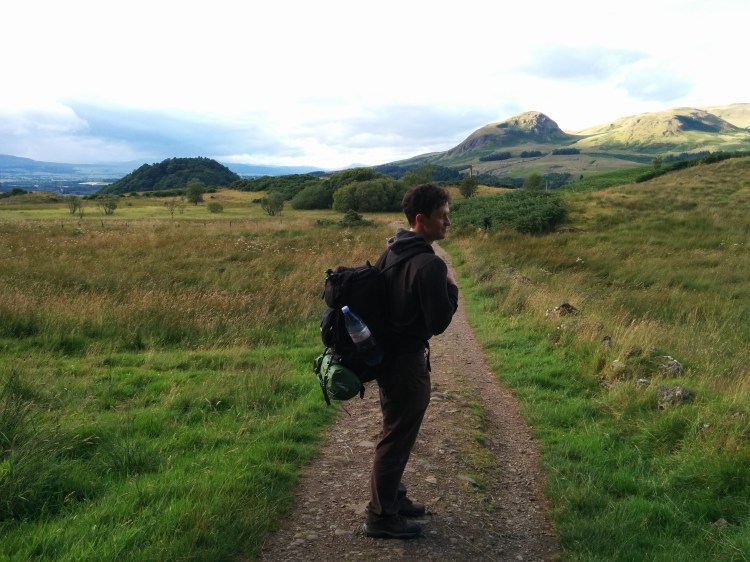
IMG_20160731_192142
Not the best back support and also pretty tiny but we made it work

We tried to pinch pennies where we could. Austin’s internship was paid, but that money typically went toward rent, eating the same spaghetti meal daily (and I am NOT exaggerating when I say that), a few side trips that we took to the Netherlands and Neuschwanstein and Austria, and I was working part-time teaching English to Koreans on the phone.

Anyway, we flew into Glasgow from London, went to an outdoor retail store, bought our tent and sleeping pad (Austin didn’t want one so it was just me), a water bottle with a filter in it, and some “Smidge” for those terrible awful midges we’d heard legends about. We ate at Five Guys as a “last meal” of sorts, and then took a bus to the town where the trail starts: Milngavie.

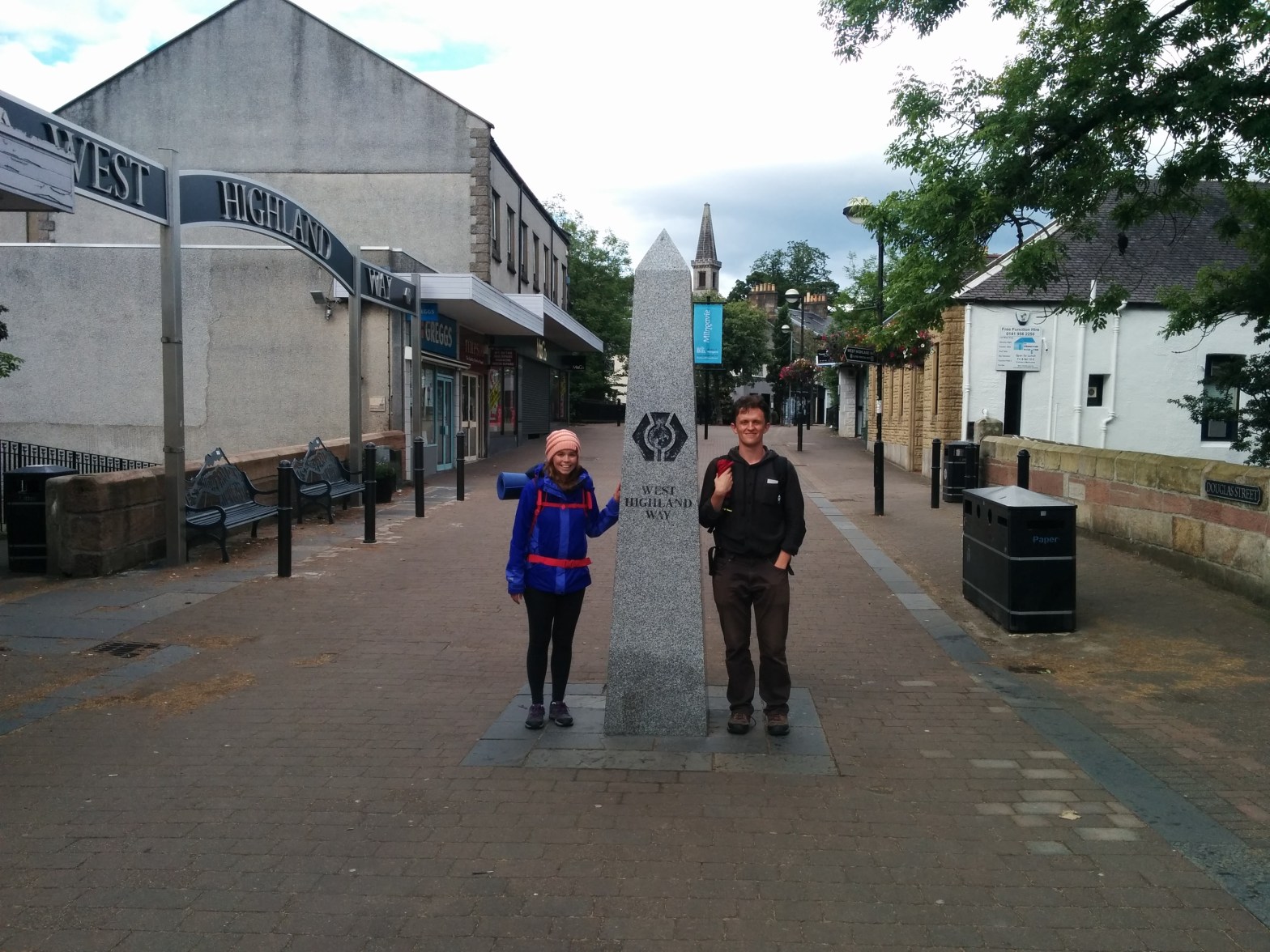
After taking a picture with the obelisk and buying ourselves some real food, we started on our way. It was pretty late in the day already – Sunday evening on the last day of July.

IMG_20160731_191459.jpg

The first 20 miles of the trail are semi-residential; you’re not exactly hiking through suburbia, but you haven’t escaped civilization either. We met a lot of people who were walking their dogs on the trail or who were out for a jog.

IMG_20160731_192044.jpg
These gates were everywhere, I’m assuming they were cattle-guards

The first night we hiked about 8 miles – it was originally intended to be shorter than that, but we were trying to find a decent camping spot while trying to outrun the midges that were starting to come out. We eventually settled on a patch that had overly long, wet grass – but the sun was setting and my feet were throbbing, so we stopped caring and threw up the tent and emotionally prepared ourselves for the rest of the trip, which I’ll be writing about for the next couple of days.

(Note: midges are awful. They are the lovechild of gnats and mosquitoes. In some areas they swarm like crazy. I will tell you more about the swarms soon.)

smidge-banner
Wee devils, awesome illustration property of Smidge

The 5 best exercises that make my knees love me

I’ve had knee problems since I was 20 – and of COURSE it comes from being stupidly competitive in a game of family kickball. No, it can’t be from me running from a bear or rescuing a baby from a runaway horse, no, it comes from overconfidence and under-competence. Fun times!

But now that I’ve been regularly physically active for the last year and a half, my knee problems have diminished significantly. These are the top exercises that have helped me the most:

Walking

If you do nothing else, walk more. I walk every day at my job whenever I can since I sit at a desk. On the days or weeks where I haven’t walked all that much, it shows in my long hikes and runs and it hurts more than it would have otherwise.

When I ran my first marathon, I ran with a pacer who had run over two dozen marathons. This was her cross-training program:

Walk on a treadmill on steep incline (like a 7.0) for 45-60 minutes.

What? No upper body? No push-ups? No kickboxing? WHAT IS WRONG WITH YOU?

But it’s incredibly effective. I have a couple of different routes I do to take breaks during work and I get in at least a couple of miles on the really good days. (Some people can walk more, but this is about the maximum I can do and still be employed.) Now that winter is approaching, I’ll be walking outside less which means I’ll be walking around the office building a lot more. I’m lucky that my work has a gym so I can just go on the treadmill, but man, those treadmills can get boring.

If you don’t have access to a treadmill or a large corporate building to walk around, then sometimes you gotta bundle up and walk outside. It’s a great way to process thoughts (I often talk to myself out loud) and it helps your knees.

Squats

Aside from giving you a butt that won’t quit, squats can help with knee pain. Not only that, they strengthen your hips, which in turn help your knees. Make sure you have correct form – it’ll make all the difference. This video should help:

Lunges

Also known as the “split-squat,” lunges have simultaneously strengthened my knees and slaughtered my thighs. When doing lunges, make sure you have a 90-degree angle with your front leg that’s lunging forward. Watch out – you’ll be hella sore the next day.

Running

Yes, really. Granted, when I’m doing a long-distance run my knees start feeling it – and there have been some murderous downhill hikes and runs I have done where my knees have declared all-out war on me – but running on varied terrain has made all the difference. When you’re going downhill on a hike or a run and your knees are dying, go slower. It’s frustrating because if you’re anything like me, you just wish this was over already. But slowing your speed can help reduce the impact.

Ellipticals, swimming, cycling

Isn’t it nice to know there’s multiple ways to exercise? There are some days where I am just NOT FEELING IT for exercising, but the elliptical machines and the bikes in the gym have come through for me. Besides, it’s a nice massage on my knees.

This is what has worked for me. I can’t speak for everyone and there are a billion ways to strengthen your knees – you can just google it and find even more exercises. But staying active and continuing to walk has made all the difference and my knees thank me for it.

What are your favorite knee exercises? What has worked for you?

Solo hiking to Donut Falls

A couple of weeks ago I hiked to Donut Falls. THERE WERE NO DONUTS. So disappointing.

20171021_133728_HDR
Not a single donut in sight

I’ve done solo hiking before, but it was always on trails I’ve already done. This one was completely new to me and honestly driving out there through the canyon was the most terrifying part of it – everyone and their dog had the exact same idea as me and people were dashing across the street and at one point I was convinced I was on a wild goose chase for this trail.

20171021_132730
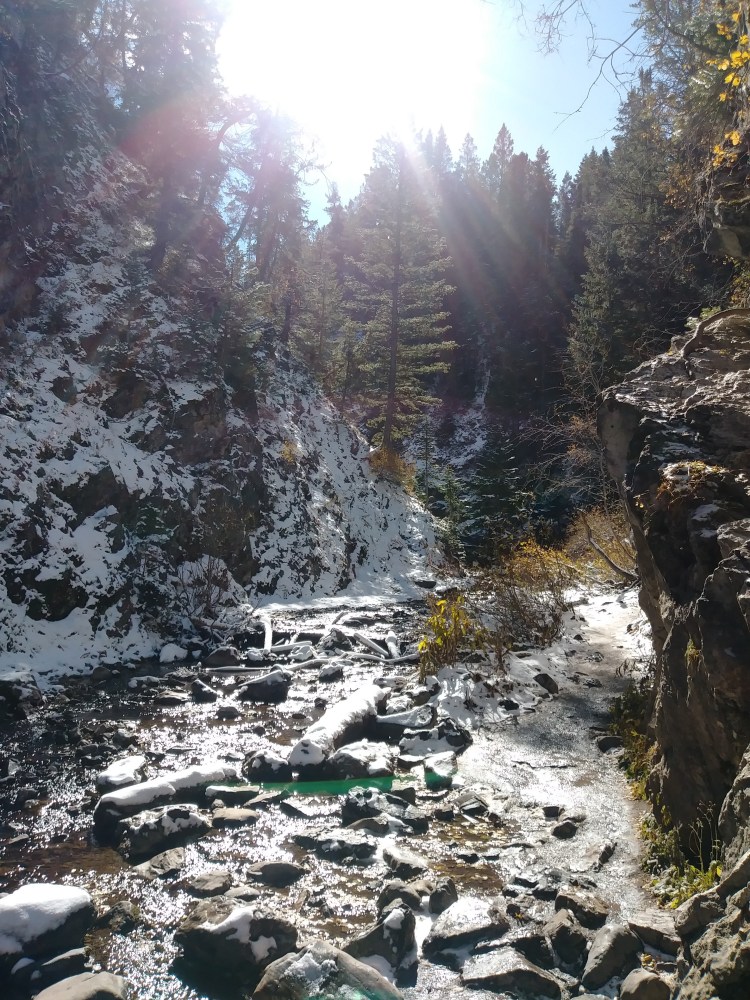
This trail was surprisingly slick

But I found it! Because I’m not afraid to ask for directions from multiple sources at all times. I asked anyone – the directions at the trailhead were kind of vague so I asked some people where to go. And I figured that given that there were so many people hiking around me, this was probably the right trail. But then I took a left where everyone else took a right and I was hiking on a very slick trail all alone. I slipped so many times that I considered turning around, but I wanted to keep going. I eventually met up with some other hikers who were returning from the hike, who told me I was on the right way.

20171021_133448

It was a pretty easy hike for the most part. However, because of the slick snow that did exist, I ended up not making it all the way up to the best part of the falls. That was me not researching it enough, because even though I’d seen pictures like this:

donutfalls
Image stolen from alltrails.com

All I was seeing was this:

20171021_134812

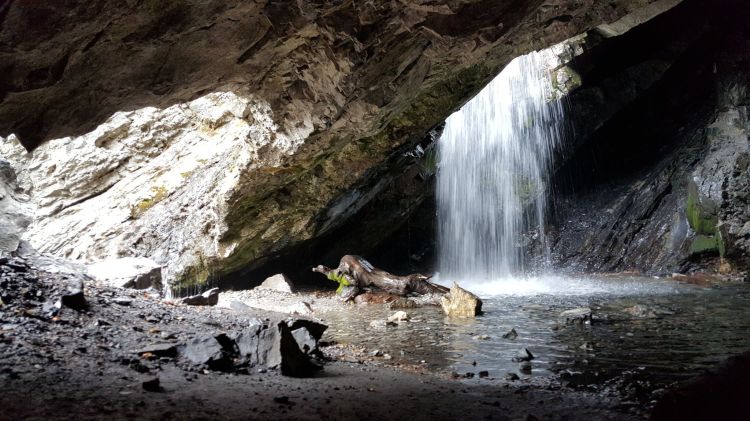
But apparently if I had kept going LEFT of the falls you see above, I would have seen a trail to go up and experience the falls in all their glory. But I saw a bunch of people sitting around taking pictures and I just thought, “oh, this must be it.”

So I climbed up those rocks in that picture and squatted in that tiny cave next to those tiny falls and took a couple of pictures and came back down and returned.

20171021_134440       20171021_134432_HDR

I kept wondering if there was just another Donut Falls (you know, such a common name for waterfalls) and looked it up when I got back.

NOPE. JUST IGNORANT.

On the bright side, it means I’ll just have to go again.

So you just hiked the worst hike in the world

Congratulations! You survived. That was awful. You will never do this again.

Except you will.

The pain fades away. The sunburn peels and turns into a tan. The blisters turn into calluses. These are actually kinda cool, you think. Badass.

You notice how many people liked that photo you posted on Generic Social Media Site. A girl at work comments on your tan skin. Another coworker casually mentions to other people that you’re the “athletic type” and you’re not used to that label.

It feels good.

Your brain starts modifying the memories without you even realizing it. You’re retelling the story to friends and family, fondly reminiscing on the time you started sobbing hysterically because you couldn’t breathe and you needed your hiking partner to slow down, I’m begging you – you’re looking at the pictures and soon, you begin rationalizing, “That hike wasn’t that bad, I could probably do it again.”

Little do you know, that hike was the gateway drug.

You start casually researching other trails. Other hikes. You even start thinking of doing that hike AGAIN, maybe avenge yourself and do it better this time. Yeah, just do that hike again.

So you go again – and boy, wow, you were wrong, this hike still sucks.

It’s like with every mile there’s something new to make it worse – maybe the trail faded and all the trigger-happy cairn builders have built one too many misleading cairns. Or perhaps there’s a lot of loose rock on a steep hill and you’re remembering a little too vividly the friend of yours who broke his femur slipping on loose shale. Or you’ve encountered a boulder field – the trail has become more “scramble” than hike by this point and despite the fact that it looks to be a couple football fields long, it takes an hour to even navigate the damn thing.

Summiting, at this point, seems less desirable.

But your own fragile ego, your overwhelming pride – the part that wants to conquer this freaking mountain already and boast that once again, I DID THE THING – keeps you going. You start to experience nausea in the thinning air, but you keep going, step by step until you hit the top of the mountain.

Reaching the summit feels amazing because you’re finally done. They helicopter you off this thing, right?

No? You mean we WALK back?

The walk back is half-agony, half-I-need-the-thing-with-feathers. Sure, the trees are pretty, and yeah, that view was stunning, and OKAY, THAT MOOSE WAS COOL TOO, but oh geez this is awful I need this to end now.

Regrets. So, so many regrets.

It takes hours to get back – less than how many it took to get to the summit, but it feels like more because you were done with this hike by the time you made it to the top. But you make it back.

Such pain. Much blister. Very exhaust. Wow.

But now it’s been a week, and hey, who wants to go for a hike?

*Note: can also apply to marathons, or any activity that exerts you so far beyond your comfort zone you might as well have been catapulted into space

3 snags you hit when you start running

Pardon the pun, but beginning running always has a few hurdles to overcome. I think that figuring out how to breathe is one of the biggest, but here are a few others that might trip you up:

1. Not the bee’s knees – Ever notice how much you love and cherish your knees when they hurt? That’s what happens when you start running – they hurt.

If you have mediocre knees like I do, then you’ve probably experienced your share of knee pain. Here’s the good news: running is actually good for your knees. That news alone has kept me going.

The problem is that I’ve still had a lot of knee pain, although I’ve noticed that it’s diminished a lot over the past year. I think when you’re doing something new with your body, things start to hurt, like how much your thighs hate you when you do lunges.

This is what I recommend if you’re experiencing knee pain: keep running, but go slower. Try to avoid going downhill – although going uphill works my knees nicely.

2. Stomach issues – I’m sure you’re familiar with the phenomenon of “runner’s poop.” Oh, you’re not? Here’s a whole TREASURE TROVE OF ARTICLES ABOUT IT.

I usually get the urge to poop in the beginning of a run, usually after I’ve gone about a mile or so. When I’ve done longer distances, it comes and goes and that makes it more difficult. I usually keep running and see how I feel.

Sometimes the urge to poop goes away. Sometimes it doesn’t. If the urge gets bad, well – pray like crazy you’re out in the wilderness and not in a city. But if you’re in a city, hey, I’ve used Taco Bell on multiple occasions.

3. Cramps – Sometimes things just hurt for no explainable reason.

The worst part about training for my second marathon was all of the stomach pain I’d had. I’d been dealing with a lot of stress at the time (y’know, the stuff that I’d rather not explain but hope that you understand because we, as humans, are collectively stressed out) and my stomach was the victim of my turmoil. Running was rarely enjoyable, but I had promised my sister I’d run with her. And so I kept running, but it wasn’t easy.

Cramps, even more than shortness of breath, are what makes running so awful. I’m still figuring out how to deal with cramps. Usually it comes from telling myself, “Just run to that telephone pole and you can stop,” and when I’ve passed the pole, I tell myself, “Keep running until you hit the streetlight, then you’re good,” and I keep going.

But there are other times where the pain is just so awful that I have to stop. That’s okay. I’ve experienced some pretty terrible runs, but I’ve also had some incredible runs. The good ones are what keeps me going.

What are problems you deal with when running? I’d love to hear what you think.

Amateur book review: Wild

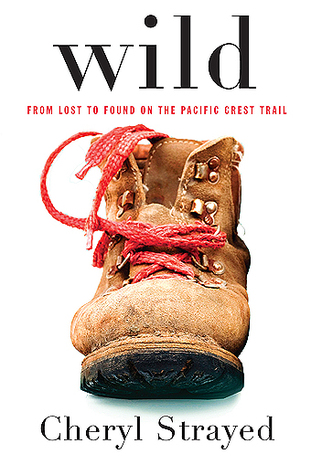
Given my ever-budding love for the outdoors, this book is like a rite of passage for outdoorsy women. Quick rundown: it’s a memoir by a woman who hiked the Pacific Crest Trail four years after the death of her mother. She’d gone completely off the deep end, did drugs, cheated on her husband excessively, and got a divorce. This hike helped her come to terms with all of that. Here are the bad and good things about it:

The Bad

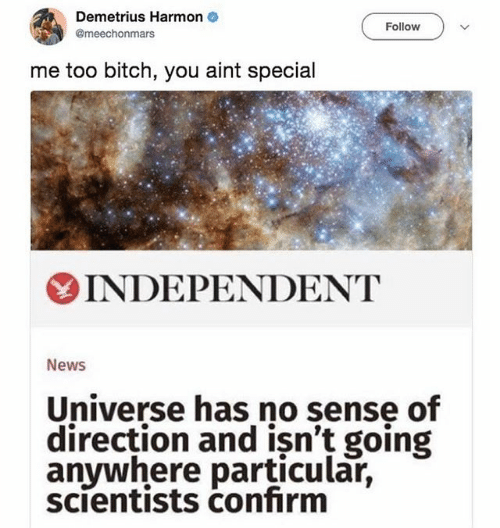
  • I struggled a lot with her life choices. She hurt people, and she hurt them bad. But that’s okay, because she was grieving! I’m sorry, but any kind of tragedy in your life doesn’t make it okay to be a self-centered, impulsive jerk. Someone has to pick up after you – I know this because I’ve seen it in my own life and I’ve seen it in other people’s lives. Death isn’t unique to most people, and everyone responds differently. This meme says it best:
    me too
  • I…I don’t feel like she really learned anything. I guess the lessons I wanted her to learn were different from the lessons she learned. This Goodreads review laid out all the flaws of the book in a hilarious way.

The Good

  • It was engaging. Maybe it’s my ability to listen to books at 2x on my phone, but I was absorbed from beginning to end. It was just plain interesting – I wanted to see what happened next and how she felt and how she’d respond. I think her writing corresponds to the kind of writing I do, and as a result I was just plain fascinated.
  • My favorite part was the part where she realized that hiking the PCT was nothing like she expected. This was more toward the middle of the book than at the end. She had expected a beautiful, cathartic amalgam in which she mulled over her mother’s death, her life choices, all with a gorgeous backdrop. She’d laugh, she’d cry, she’d watch sunsets in a contemplative manner, and she’d ultimately become one with the universe. Instead, she was forced to think only about her present situation: her aching feet, her obscenely heavy backpack (that she later nicknamed “monster”), her survival, whether or not she had enough water and food, etc. And that’s EXACTLY what I’ve experienced while backpacking long distances and hiking difficult mountains. People often talk about how good the outdoors are for mental health. Is it because it forces you to stop thinking about your problems and focus on, y’know, NOT DYING? Because that’s been my experience.

If you don’t read this book, you won’t miss much. I still enjoyed it, despite its flaws. It’s readable for sure, makes you want to embark on your own soul-searching journey, but please don’t be as thoughtless as her.

Winter hiking 101: do’s and don’ts of snowshoeing

Do spell it “snowshoeing.” Not snowshoeng, snoshooing, or snowshuing. Think of Boeing. All those vowels together. It…it makes more sense in my head.

Don’t use snowshoes on well-trafficked terrain. I mean, you can if you want. But this is a waste of perfectly good snowshoes and is much slower. If you plan to go on a particular trail, just carry the shoes until you hit powder – THEN you can go to town.

Do use snowshoes in deep snow. When traversing straight-up powder, snowshoes are your best friend. Have you ever walked through powder in just hiking boots? The snow wedges its way in between your snowpants, boots, socks, and freezes right on your skin. It has formed a path for more snow. This is your life now.

IMG_20170115_135843

But it doesn’t have to be this way if you wear snowshoes! It’s like walking on water in those rad boat-shoes Leonardo da Vinci wore in the movie Ever After. You sink slightly, but not all the way, and then you start trekking through forests and singing with birds and sweating with panache.

Don’t go overboard on the sunscreen. Yes, you should wear sunscreen. But speaking as someone who had puffy, stinging eyes that were more watery than the Titanic, use reservation. Accept that you might burn a little because it’s better to be burned than to suddenly channel your inner Toph. Maybe this isn’t something you need to remind yourself. This is definitely more for me.

Do go exploring. There is something so rad about going way, way beyond where other people are – although make sure you are within decent walking distance in case something happens. But go beyond – go to where humans disappear entirely and immerse yourself in the silence. And then panic slightly because whoa, what if you die out here?

Don’t stay in your comfort zone. Keep walking, sweat more, shed layers, discard your coat on the path because it’s likely nobody will steal it (no promises, though), and keep moving. And then when you’re done, pick up your coat, go home, and binge-watch Stranger Things again. That show’s awesome.

Winter hiking 101: 5 basics

I love hiking in the winter. I don’t do it every weekend – binge watching a new series is always fun – but when I do, it’s pretty magical, right up there with unicorns and the ageless Paul Rudd.

If you hate being cold (which I do) and don’t want to ruin that, then winter hiking might not be your thing. That’s okay! But if you hate cold AND you’re feeling jealous of perfect Jenny Beckman who hiked that ridiculous mountain with her hardcore friends and you want to one-up her, then this is for you. Trust me, I’ve been there.

1. Over-prepare

IMG_20170107_144934

I’m not saying bring sled dogs and musk ox pelts to keep you alive (although if you have those, wow, I’m honored that you’re reading my blog), but hey, maybe wearing an undershirt, overshirt, sweatshirt, sweater, jacket, coat, hat, scarf, snow pants and overlarge boots isn’t too bad of an idea! It helps you realize that 1) Wow, the weather isn’t as bad as I thought and 2) Liesl, you’re such a wuss and 3) layers make the outside bearable.

If you over-prepare, be ready to peel off layers and carry them with you. This is what backpacks are for. That and lots of water, some food, and your phone for when you get lost and need to find the nearest McDonald’s.

2. Start off in well-trafficked areas

No backcountry for you! Unless you’re with some guide who knows what’s up. But if this is your first time, I’d go where everyone else goes. It’s great to be unique and think creatively, but when it comes to hiking in the winter, especially when it’s snowing, it’s just smarter to do what everyone else does.

Stay on the trail. If you hike a certain trail in the summer, it’s likely to be just as good in the winter. Living in Utah allows for a lot of different hikes and I’ve seen some cool things. An advantage of hiking in the snow is that you can go shorter distances and still work up a sweat and experience the ~magic~ of walking in a winter wonderland. That way you don’t venture too far beyond your comfort zone, but still have a fantastic time.

3. Avoid bad weather, ideally go during the day

This should be a “no duh” for most people, but surprise! People are fools. I don’t care how hardcore you think are or that you were a scout at one point. I have done dumb things myself, like hiking with minimal water or being caught in the middle of a storm. Don’t be dumb like me. Be smart, especially by yourself. Tell someone where you’re going, check the damn weather, and go during the day when visibility is best.

4. Just keep moving

This is a good rule of thumb, but it becomes an especially important rule with the higher elevation you get and the longer you stay out. I once hiked Y Mountain in January with my husband and when we stopped for lunch, we discovered that our peanut butter sandwiches were freezing, our water was freezing, and if we didn’t start moving soon, we’d be freezing. It was hard – some parts of Y Mountain are pretty steep and we were moving slower than a beached whale. But as soon as we started moving, we warmed right up.

5. You don’t need to be a pro

IMG_20170125_171628

Just go. You don’t need crampons or hiking sticks, although those will help. I have gone hiking in the snow wearing just my trail running shoes and while I have emerged with slightly damp feet, it was a ton of fun. In my opinion, getting outside and hiking has raised my confidence, given me a workout that’s 20 times more interesting and fun than running on a treadmill, and given me a higher tolerance for pain. Now that’s impressive.

Couch potato to 5k: how I got off my butt and started running, part 2

Last May, I ran my first ever marathon. How the hell did I ever get into running?

To be honest, the running I do is probably more accurately described as “jogging,” but I hate that word because it makes it sound like you’re putting in the tiniest effort possible to achieve minimum results – although let’s be honest, that’s how I run.

I just hate the word “jogging,” mostly for it’s wuss-sounding connotations. Jogging is a lot harder than it sounds, and being an utterly average human being, I still think that it’s worthwhile, especially when you’re getting into the exercise realm. I’ll continue to call it running, thankyouverymuch.

I had often heard the advice of “start small,” and “the only way to eat an elephant is a little bit at a time,” and after contemplating the disturbingly intriguing nature of eating elephants, I decided that I would start running. And lucky me, I had just graduated college, Austin and I were living in Germany for an internship of his, and I was working part-time over the phone. I had a lot of time to kill.

I thought I’d start “small” and run 3 miles. 3 felt like a good, solid number. Avenge the 9th grade failed 5k. Yes.

I made it 1 mile.

There was a hill in the way. A terrible, awful hill.

IMG_20160607_193120
This hill doesn’t look that bad but TRUST ME IT’S TERRIBLE.

The hill was right behind our apartment complex and since we lived in the middle of an incline, I didn’t exactly have a choice. It was either go downhill and come back up (not ideal) or go up and then come down (slightly more ideal). Austin had previously told me there’s no shame in stopping, and so I would stop and walk a little and then start running again and 5 seconds later stop to gasp for air.

Good ol’ running.

How I hated it.

How badly I just wanted to feel the infamous “runner’s high,” but how I also did NOT want to run for 30 minutes solid until I felt that.

That night I ranted to Austin about how hard it was and how frustrated I was that I wasn’t better RIGHT THEN. So he and I went out for a run and he ran behind me to observe my form.

“You’re running too fast,” he said.

I angrily responded, “This is what running IS! IT’S FAST.”

(Because you should always yell at people you love when they’re trying to help)

“No, you can go slower. Here, let me show you how to run uphill.”

He started zig-zagging across the narrow road, turning his body so it was like he was running up invisible miniature switchbacks on the road. He ran slowly, and I tried to imitate him.

“I’m barely going faster than walking,” I whined.

“That’s okay! If you aren’t enjoying your run, you’re going too fast,” Austin said. “It’s okay to slow down. Running up hills like this will help increase your lung capacity too.”

I suddenly remembered swimming with Austin in a diving pool. I was swimming on top of the water when I saw Austin swim 6 feet under me and all the way to the other side and back without even surfacing to catch his breath. I wanted that. I wanted to be that mermaid.

“I want to go home now,” I said. “But I’ll try again tomorrow.”

So, I returned to the hill. I did the switchbacks. I ran so slowly, I looked like I was reenacting the end of Chariots of Fire.

There was a mixture of running and walking – but one day I finally got up that hill without ever stopping. I’d say the hill was about 1/3 of a mile, but that’s 1/3 of a mile of VERTICAL GAIN, HOLY HANNAH SHOOT ME NOW.

One day, I finally got up the hill and actually enjoyed my run.

I had stopped once, but I told myself that even though I could stop, I had a new feeling: I didn’t want to stop. So I kept going. I ran through the forest, past small houses and down a gravel road until I saw yellow canola fields and giant windmills rising above the trees.

Maybe that was the runner’s high making me crazy? Maybe I was Don Quixote – those windmills were pretty large. But I ended up outside this tiny adorable German village, I was surrounded by yellow flowers, and I finally ran the 3 miles I was aiming for, and I started building on that and stacked more miles on top of it.

As I continued to run every other day, I had discovered that running on flat or downhill or even gradual uphill surfaces enables you to catch your breath more easily. I got used to being out of breath – I somehow knew that I’d be able to breathe; I’d be okay.

What helped the most was just running slowly.

Slow enough that I stop praying for the sweet release of death; slow enough that I’m still running and I can pay attention to other things going on, like my stomach pain or the sudden urges to poop.

Hey, it’s a work in progress.

Running is hard in the beginning. I don’t think there’s any other way around it. But I’ve found so much immense satisfaction in pushing myself, in becoming stronger, and I even lost some of the baby fat from my face. It’s definitely worth it.